Marketing Strategies to Attract the Right Customers (Not Just Followers!)
Attract: Part 1 of The ACCN Marketing Framework
If you're a small business owner trying to figure out the best marketing strategies to attract customers, you've probably heard a lot of advice. Post more on Instagram! Get more followers! Boost your reach! Be everywhere all the time!
And yes, getting in front of people is important… if they don’t know you exist, they can't work with or buy from you. But traditional marketing advice around attracting customers is often incomplete, more focused on increasing follower counts than actually, specifically bringing the right people to your business!
So that’s why I want to talk you through strategic customer attraction for small businesses - what it really means, how it works, and why getting discovered is just the beginning (not the end goal).
(Quick reminder: Attract is one part of the ACCN Marketing Framework, which examines your full marketing ecosystem through four components: Attract, Connect, Convert, and Nurture. Effective marketing isn't about doing just one thing really well; it's about making sure all four essential pieces work together as an ecosystem.
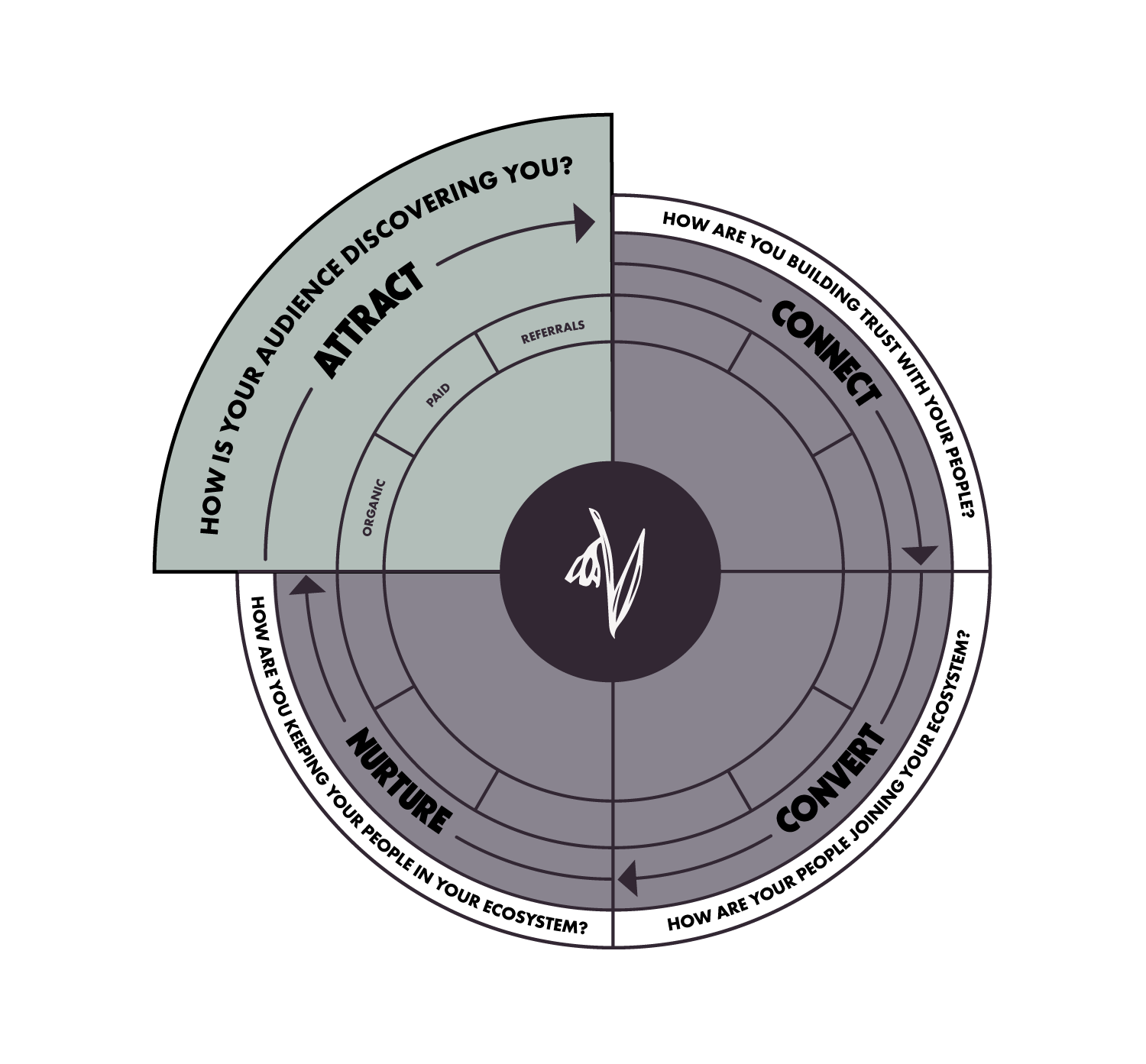
If you haven't read the ACCN overview post yet, start there for the overview of how all the pieces fit together!
A Different Perspective on Attracting an Audience for Your Business
When you think about strategies to attract customers and clients, you’re probably thinking about follower counts, traffic numbers, how many people see a post, that kind of thing. Basically: trying to get more people in the loop and more eyeballs on what you do.
But my perspective on what Attract actually means is more nuanced: making it easy for the right people to find you when they're looking for what you offer.
Note that I didn’t just say “more people!” We’re talking about the right people. The ones who actually need your services, who are in your service area, who align with what you do.
This is a really important distinction! You could have 10,000 Instagram followers, but if only a fraction of them are actual potential clients, that’s not doing your business much good. Same as if you were getting tons of website traffic, but mostly by accident or because people were looking for something you don’t offer. In these cases, increased numbers don’t actually help your business.
So strategically attracting people is about quality and relevance, not just quantity.
It means showing up where your ideal clients are actually looking. It means using the language they're searching for. It means making your business discoverable through the channels that make sense for your specific audience and business model.
And (super important!) it means not exhausting yourself trying to be visible to more people everywhere all the time. Strategic visibility is sustainable. Constant hustle isn't.
So when we talk about strengthening the Attract piece of your marketing system, we're not talking about gaming algorithms or chasing follower counts. We're talking about making it genuinely easier for people who need what you offer to actually find you.
Key Marketing Strategies to Attract Customers to Your Business
Okay, so what do strategic customer attraction efforts actually look like in practice? Let me break down the key pieces.
→ SEO and website discoverability
This is how people find you when they're searching Google for what you do. It includes things like:
Is your website set up so search engines can actually understand what you offer?
Are you using the terms and phrases your ideal clients are typing into search bars?
When someone searches for "[your service] in [your city]," do you show up?
I know that SEO can sound or feel really intimidating, and that’s (understandably!) why a lot of small business owners kind of avoid it. But putting some SEO foundations in place is important, and is probably not as overwhelming as you think.
→ Keyword strategy
This ties into SEO, but it's worth calling out separately. What words and phrases are your ideal clients actually using when they look for someone like you? And are you using those same terms in your website copy and online profiles?
Sometimes there's a disconnect between how you describe what you do (industry jargon or overly creative language) and how potential clients are actually searching. Closing that gap makes you so much more discoverable.
→ Platform setup and optimization
This includes places like your social media profiles, your Google Business listing, and directories relevant to your industry. Are your profiles complete, accurate, and optimized? Are they actually working to help people find you and understand what you do?
This stuff might seem basic, but you'd be surprised how many businesses have incomplete profiles or information that doesn't match across platforms. (Or maybe you’re not surprised, if you’ve ever had to check Facebook and Instagram and Google just to figure out if the local ice cream spot is open for the season yet. 😆)
→ Strategic visibility that makes sense for you
This is about being discoverable without burning yourself out. It's not "post three times a day on Instagram!" It's more like:
What channels make sense for reaching your specific audience?
How can you show up consistently in ways that are sustainable for you?
And it’s definitely worth mentioning that this can absolutely include offline stuff! Maybe you’re active in a couple of local community groups. Maybe flyering around your town and leaving brochures in a couple key locations (yes, actual pieces of paper!) works really well for you!
The key is that your efforts fit your business and your capacity, and that you’re actually reaching the people you want to reach.
How to Find Your Client & Customer Attraction Gaps
There are some common spots where your Attract efforts can often be strengthened. Some of the patterns I see over and over when I'm doing Strategic Audits for clients include…
Your website isn't optimized for search
This is probably the most common gap. Your website looks beautiful (and you might have even worked with a professional designer) but when I dig into the backend, there's no SEO foundation. Page titles are generic. There are no meta descriptions. Headers aren't structured properly. The copy doesn't include the keywords people are actually searching for.
Why does this happen? Usually because the focus was entirely on design (how it looks) without consideration for discoverability (how people find it). Both matter! But if your gorgeous website isn't showing up when potential clients search for what you do, it's not working as hard as it could.
Social profiles are incomplete or inaccurate
Does your Instagram bio just say… your business name? No description of what you do, no location, maybe even no link? Or maybe you have a Facebook page, but you haven’t touched it in two years and there’s a lot of stuff on there that’s inaccurate now.
This happens because setting up profiles feels like a one-time task that got checked off the list, but it takes a bit of intention to keep them updated as the years go by and your business evolves!
Reliance on just one channel
Maybe you're all-in on Instagram, or you're getting all your business through word of mouth. And look, if something's working, great! But relying on a single discovery channel does make your business vulnerable.
Instagram can change the algorithm whenever they want. People who are awesome referral sources for you could move away or retire. Potential clients and customers might prefer to find you through Google instead of spending time on social media.
I worked with a client who had a really solid Instagram presence, but when we looked at her website analytics, she was getting almost zero traffic from search. She was kind of invisible to anyone who wasn't already on Instagram! So we put more focus into improving her search results, adding another discovery channel to complement the results she was getting from social media.
You don’t need to have eggs in every single basket out there, but it’s not awesome to have them all in one basket either.
Attracting the wrong people
This one's tricky because it can look like your Attract efforts are working - you're getting followers, traffic, maybe even inquiries - but it turns out that the people finding you aren't actually a fit for what you offer.
This often happens when your messaging isn't clear about who you serve or what you do. Or you're using keywords that bring in the wrong audience. (Or you go viral for a piece of content that isn’t really what your business is about… for example an inspirational quote post brings in thousands of new followers, but you’re an interior designer - there’s a mismatch there!)
Being specific about your ideal client or customer, rather than being too broad and trying to be everything to everyone, really helps here!
To be super clear, most Attract gaps aren't because you’re not trying hard enough! They're more often about not having the foundational pieces set up strategically, and that’s something that’s really doable to change.
Getting Started: 4 Ways to Improve Your Customer Attraction Strategy
If you're reading this and realizing the Attract part of your marketing ecosystem has some gaps, here are some practical places to start. You don't need to do all of these at once! Pick 1-2 that make the most sense for your business and start there.
Check out your current discoverability
Google yourself (or your business name) and see what comes up. Then search for "[your service] in [your city]" (if your location is relevant to your business) and see if you appear (quick note - use a “guest” or “incognito” browser for this, since Google is more likely to show your information to you if you’ve searched for yourself before, or if you have a Google Business profile set up).
What kind of information would a potential client or customer be able to quickly find about you?
Complete and optimize your social profiles
Make sure your bios clearly state what you do, who you serve, and where you're located. Add relevant links, use an on-brand profile photo, and fill out every field that's available. It sounds basic, but this is where a lot of businesses lose potential clients simply because the information isn't there! (These are often quick wins to fix, too, and who doesn’t love a quick win?!)
Get your Google Business Profile in order
If you serve clients locally, this is huge. Claim your profile if you haven't, fill out every section, add photos, and make sure your hours and contact info are accurate. This often gets overlooked, but it's one of the most straightforward ways to show up in local searches. And it can be another quick win!
Optimize your website for basic SEO
You don't need to become an SEO expert, but make sure the foundations are there. Each page should have a clear title and meta description. Use headers (H1, H2, etc.) properly. Include the terms your ideal clients are actually searching for in your copy. (And if this feels overwhelming, this is exactly the kind of thing a Strategic Audit identifies and prioritizes for you!)
Ready to Strengthen How You Attract New Customers and Clients?
If you're not sure where your gaps in customer attraction are, if the tech side feels overwhelming, or if you've tried optimizing on your own and aren't seeing results, that's when bringing in strategic support makes sense. A Strategic Audit looks at your full Attract picture and tells you exactly what to prioritize and why.
We also look at all four components of your marketing ecosystem - Attract, Connect, Convert, and Nurture - to see what's working, where the opportunities are, and what deserves your attention first.
That’s because Attract is only the beginning. Getting discovered by the right people matters, but what happens after they find you matters just as much!
To keep learning about the ACCN Marketing Framework, check out the next post in the series about Connect: How to Build Strong Customer Relationships Through Marketing.
We’ve just covered what it means to Attract people, but once someone discovers your business, the next question is: will they stick around? Will they understand what you offer? Will they trust you enough to take the next step? That’s what the Connect piece is all about!