What Happens When Strategy, Design, and Marketing Finally Work Together in Your Business
Most marketing advice only gives you one piece of the puzzle. Here's what happens when you finally have all three.
If you’re like many business owners, chances are that you’ve invested in some kind of design or marketing support before. After all, it’s overwhelming to try to DIY your branding and then build a website AND keep up with sending email newsletters AND post consistently on social media AND actually do what you started your business to do… just to name a few.
Maybe you hired a brand designer and got gorgeous brand assets, like a beautiful logo, a cohesive color palette, and fonts that feel just right. Or maybe at some point you worked with a marketing strategist and walked away with a super solid analysis, full of smart insights about your audience and a direction for growth.
But then... What happened after that?
It’s super common (and there’s no shame!) if those stunning brand assets are still sitting pretty in a folder on your desktop, and you're not entirely sure how to actually use the bits and pieces and files in there.
And that marketing plan might have suffered a similar fate. It made total sense when you reviewed it together, but “Yes, this looks great!” in theory can easily fade into “How do I actually… do this…?” in practice.
If this all sounds familiar, it's not that what you received wasn't valuable. It absolutely was! But there's often a gap between having these pieces and knowing how to make them work together in your day-to-day marketing.
That's because strategy, design, and marketing are almost always treated as separate services, when really, they need each other to be truly effective.
When all three work together from the start, something shifts. Your marketing doesn't just look good OR work strategically; it does both, because all the pieces are finally connected.
That’s why I am ALL about the intersection of strategy, marketing, and design in my services, and I’m here to help you understand how this can work for you in your own business!
Let's look at how small businesses usually approach their marketing and brand development.
When you think, “Hmm, I need someone to help me with my marketing,” these are the types of professionals who probably come to mind:
Brand designers specialize in creating beautiful visual identities. They develop logos, choose color palettes, select typography… basically, they create a visual look and feel that sums up the essence of your business. It’s important work that gives your business a professional-looking image, which helps build trust and recognition with your people.
Marketing strategists focus on the big picture planning. They’re great at zooming out, checking out your audience and your competitors, and then coming up with a plan for how you could reach your goals through marketing (like more visibility, more sales, etc).
There are also marketing agencies and specialists (they call themselves a range of things!) who can handle the doing. They manage your social media, run your ads, send your emails, and keep your marketing machine running. They're focused on getting things done and making sure that you’re consistently putting content out there.
And this is all awesome. But… these are all different people with different specialties.
The challenge this creates for you as a business owner (that you might have encountered already) is that you end up with several valuable pieces, but the job of connecting them all and making them work together cohesively? That becomes your responsibility.
So you have a Dropbox full of brand assets with detailed guidelines, or a big document that outlines your content pillars and target audience, but you’re left wondering: okay, but what should my Instagram grid actually look like? How do I make sure my emails feel cohesive with everything else? What should I even write about and how do I make it look good and how do I make the time to do this and what happens after I press “send”???
That’s how you know you’re in the strategy vs. marketing vs. design gap. And it can be a tough place to be, especially if you’ve already invested resources, time, and energy in wrangling the separate pieces.
The sweet spot: When strategy, design, and marketing all work together
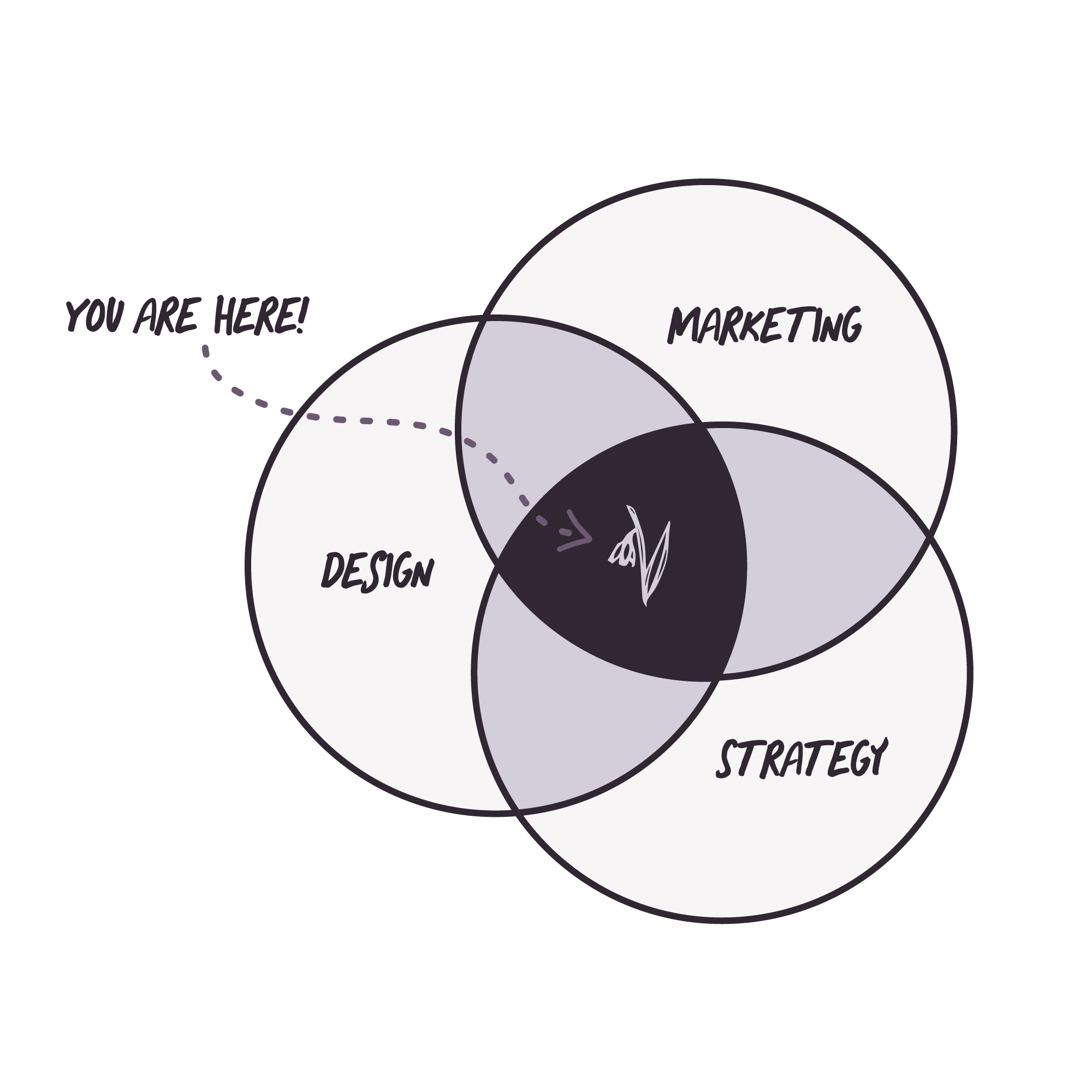
So how does it work when strategy, design, and marketing actually align from the start? What’s the middle slice of that Venn diagram?
→ Strategy is informed by your goals, and shapes what you create and why.
→ Design makes everything look professional, recognizable, and clear.
→ And marketing brings it all to life, consistently, in front of the people who need to see it, nurturing strong relationships with them over time.
All three, working together in a cohesive and intentional way.
Let me show you what I mean with some real examples.
1. Email
With this type of integrated approach, your newsletter actually moves the needle in your business (instead of stressing you out, checking a box, or randomly filling up someone’s inbox!)
→ Strategy determines the goal (are we nurturing past clients? introducing a new service? staying top of mind?) and shapes the content approach. What topics will resonate with your people? What's the right frequency so you're helpful without being overwhelming? How does this fit into your bigger marketing ecosystem?
→ Design involves creating an on-brand template and graphics that make your newsletters instantly recognizable and professional-looking. Colors, fonts, your visual style, your awesome photos… all there, making every newsletter feel like a natural extension of your brand. Plus, the template is set up so it's actually easy for you (or me!) to use each time. Design also means making sure your reader’s experience is great - that emails are skimmable, optimized for mobile, work in dark mode, have alt text for all images, and have context for people who are might not be sure why they’re on your newsletter list.
→ And marketing execution means it actually gets written, designed, and sent consistently. Not sitting in your head as an idea that you don’t know how to make happen. Not "I'll get to it next month"... every month. (No shame!) It’s out there, it’s intentional, and you have systems in place to keep it sustainable.
This is how email marketing starts generating real results - more engagement, better client relationships, and increased sales.
(There’s a reason that email marketing done well has just about the highest return on investment for any small business marketing channel!)
2. Your social media presence
I know, I know… social media is a love/hate relationship for so many small business owners. What I can say for sure is that it’s infinitely more frustrating when you’re posting randomly/out of a feeling of “I should do this”/hoping something sticks, and infinitely more rewarding when you have a plan, strategy, and systems to make it easier.
→ Here, strategy identifies which platforms actually make sense for your business and what kind of content will connect with your ideal clients and get you to your goals. (Spoiler: you don't need to be everywhere! We’ll focus on being where your people are.) It also shapes content themes that resonate with your ideal people and make sense for your business’s goals so you're not just randomly posting whatever comes to mind (and then wondering why no one is engaging).
→ Design ensures every post feels cohesive with your brand, whether it's a behind-the-scenes story or a polished graphic. Your visual presence becomes recognizable. People scroll past and think "oh, that's definitely [your business]" before they even read the caption. Templates make creation easier, and everything from your profile to your posts to your highlights works together visually.
→ And then marketing execution means you're showing up consistently with content that's actually planned and purposeful, not scrambled together at the last minute because you realized you haven't posted in two weeks.
That doesn’t sound as bad, right?!
3. Your website
Your website needs to be a total workhorse for your business, and there’s a lot involved in that. It needs to be engaging, easy to navigate, full of helpful info, visually appealing, and technically built in a way that sets you up for success.
→ Strategy shapes the overall structure and user journey. What do people need to understand about what you do? What questions do they have? What should they do next? How do we guide them from "just browsing" to "I want to work with this person"?
→ Design creates an experience that's both beautiful and functional. It's not just about making things pretty, it's about making sure people can find what they need, that your brand personality comes through, and that every page reinforces who you are and what you offer. Good design also means your site actually works well on phones (since that's where most people are browsing!).
→ Marketing optimization means your site is set up to be found. Basic SEO is handled, your pages load quickly, you're capturing emails from interested visitors, and you have clear calls-to-action that guide people toward working with you.
The result is a website that doesn't just exist out there in the world, it works. It looks professional, it communicates clearly, and it actively supports your business growth.
Here's the thread that ties all of this together:
When strategy, design, and marketing work as one integrated approach, your marketing doesn't just look good OR work strategically, it does both. Every piece reinforces the others. Your emails look like your social posts look like your website. Your content serves your strategy. Your strategy gets implemented beautifully.
All of it is specifically, actively, and intentionally helping you get in front of new people, nurture existing relationships, and grow your business in ways that are aligned with your real goals.
This is what I mean by taking your brand from "on paper" to "in action." It's not enough to just have the pieces. They need to work together, out in the wild, doing their job while you focus on doing yours.
What this means for you (and your business growth)
Okay, so we've talked about the integrated Strategy/Design/Marketing approach and what it looks like in practice. But let's get specific about what this actually means for you and your business.
→ You don't have to be the juggler/connector/“Did we think of this???” anymore.
Right now, you might be the one trying to figure out how to apply your brand guidelines to your email template. Or how to take your content strategy and turn it into actual social posts. Or how the heck to update your website (and figure out what to even put on there) since nobody’s touched it in a handful of years.
When strategy, design, and marketing work together from the start, that translation work isn't your job anymore. Someone (that’s me, when we work together!) who understands all three pieces can see how they fit together and make it happen. You're not stuck in the middle, trying to bridge gaps between different providers or figure out how to implement advice that doesn't quite account for your visual brand.
Your marketing efforts actually connect to each other instead of existing as separate, disconnected tasks on your to-do list.
→ Ideas actually get implemented.
This might be the biggest shift. It's one thing to have a plan. It's another thing to have beautiful brand assets. But having marketing that's actually out in the world, consistently working for your business? That's what moves the needle.
When all three pieces work together, you get real marketing that's happening, not just sitting in a strategy document or a folder of unused templates. Your newsletters go out. Your social content gets posted. Your website gets updated. The gap between "brand on paper" and "brand in action" finally closes because someone is handling the strategy, the design, AND the doing.
And that consistent implementation is what creates results. It’s hard to build momentum with kind of sporadic, disconnected marketing, even if each individual piece is good. Showing up regularly, looking professional, and staying aligned with your goals gets you recognized, remembered, and referred to.
→ Your whole brand presence becomes genuinely cohesive.
When people encounter your business, whether it's through an Instagram post, an email, your website, or even a printed flyer, it all feels like it looks, sounds, and comes from the same place.
This isn't only about aesthetics (though that matters too!). Cohesion builds trust. When everything you put out there feels intentional and connected, people get a clear sense of who you are and what you're about. They start to recognize you. They remember you. And when they need what you offer, you're the one they think of.
Compare that to marketing that feels pieced together - a little of this, a little of that, nothing quite matching. It's not that any individual piece is bad, but the overall impression is scattered. And scattered doesn't stick in people's minds the way a strong, consistent presence does.
→ You get sustainable, strategic growth.
Here's what I really want you to take away: this approach is NOT about getting more eyeballs on your business for the sake of vanity metrics. It's about creating the kind of marketing that builds real, long-term relationships with your people.
When your marketing is thoughtfully created, intentionally designed, and consistently executed, you naturally stay top of mind for past clients and potential customers. You become memorable. You build an amazing reputation. You're connecting with people in ways that genuinely matter.
This all leads to the sweet spot of stronger client relationships, more referrals, increased retention, and the kind of organic growth that doesn't require you to constantly be hustling for the next client. You're building something sustainable, where your marketing actively supports your business over the long haul instead of just creating short-term spikes of attention.
What are your strategy + design + marketing challenges right now?
Let me share some patterns I've noticed working with clients over the years, because chances are, if these sound familiar, you're in a great spot to benefit from this integrated approach.
You have brand assets but you don’t really know what to do with them.
So many of my clients are in this boat! One client, a real estate team, had invested in professional branding but their newsletters, social posts, and marketing materials didn't reflect any of it. Everything felt disconnected, inconsistent, and wasn’t reflecting the high level of service they were offering their clients.
After we started working together, we took those brand assets and actually put them to work across every touchpoint. Now their emails, social presence, and print materials all feel cohesive and professional. Their audience knows where to go for information, and their website is easy to navigate. They've told me that the updated branding has led to more listings and impressed clients who have referred them to great people, because now their marketing actually reflects the quality of their work. (Lightbulb moment!)
Your marketing ideas keep getting pushed to tomorrow, next month, or never.
I hear this one all the time: “I know I should be sending newsletters. I have content ideas. I understand consistency matters. But I just can't seem to make it happen.”
A former football coach-turned-speaker-and-author I worked with had this challenge. He was about to publish a book, but didn’t really have any digital presence to speak of… and it wasn’t something he could put off any longer! He knew it was something he needed but had no idea where or how to start.
Working together, we created his entire digital marketing presence and led the book marketing efforts. The result was SO cool: he broke his publisher's pre-sale record and became an Amazon bestseller in six categories.
Having someone handle the strategy, design, and execution meant that he could really make the most of releasing the book, knowing that his audience had a place to go to stay in touch and find more information instead of hitting a dead end.
Everything you're doing involving your marketing feels scattered or disconnected.
A lot of clients come to me when they have been putting effort into marketing, but they’re not seeing much (or any) benefit from their patchwork-y efforts.
One website designer client had been trying to DIY her social media marketing, and while she was showing up, nothing felt cohesive. Her Instagram didn't match her overall brand, and she wasn't sure if any of it was actually helping her business grow.
After working together for just three months, she'd earned back her initial investment plus an additional $3,300 in client work from Instagram alone. But beyond the ROI, she told me: "Before working with Cecilia I pretty much hated doing Instagram for my business—it was stressful, didn't feel like me, and was getting me zero results."
Having all three pieces - strategy, design, and execution - work together made Instagram actually effective for her business instead of just another exhausting task.
If any of these situations sound familiar, you're exactly the kind of business owner who can benefit from the strategy-design-marketing approach (and exactly the kind of person I love working with!)
My clients typically come to me when they're ready to close the gap between where their marketing is now and where it needs to be, and they don't want to keep piecing it together on their own. They want someone who can see the strategy, create the designs, and actually make it all happen consistently.
And that’s exactly what I bring to our partnership. I have your back with the strategy that guides everything we do, the design that makes it professional and recognizable, and the execution that gets it out into the world consistently.
If you're ready to stop piecing things together on your own and start seeing your brand actually work out in the wild, let's connect. Your brand on paper is just the beginning… let's put it into action!
To learn more about getting started working together, check out the Strategic Audit. We always start there to see the full picture of where you are now and where you want to go. From there, we can bring strategy, design, and marketing together through ongoing support that's customized to your business and goals.